

Rectified Rotary Position Embeddings#
Using Rectified Rotary Position Embeddings (ReRoPE), we can more effectively extend the context length of LLM without the need for fine-tuning. This is about the Triton implementation of ReRoPE and its integration into the vLLM inference framework.
🚀 ReRoPE | 📄 blog [https://kexue.fm/archives/9708] [https://normxu.github.io/Rethinking-Rotary-Position-Embedding-3]


🌟 What is ReRoPE?#
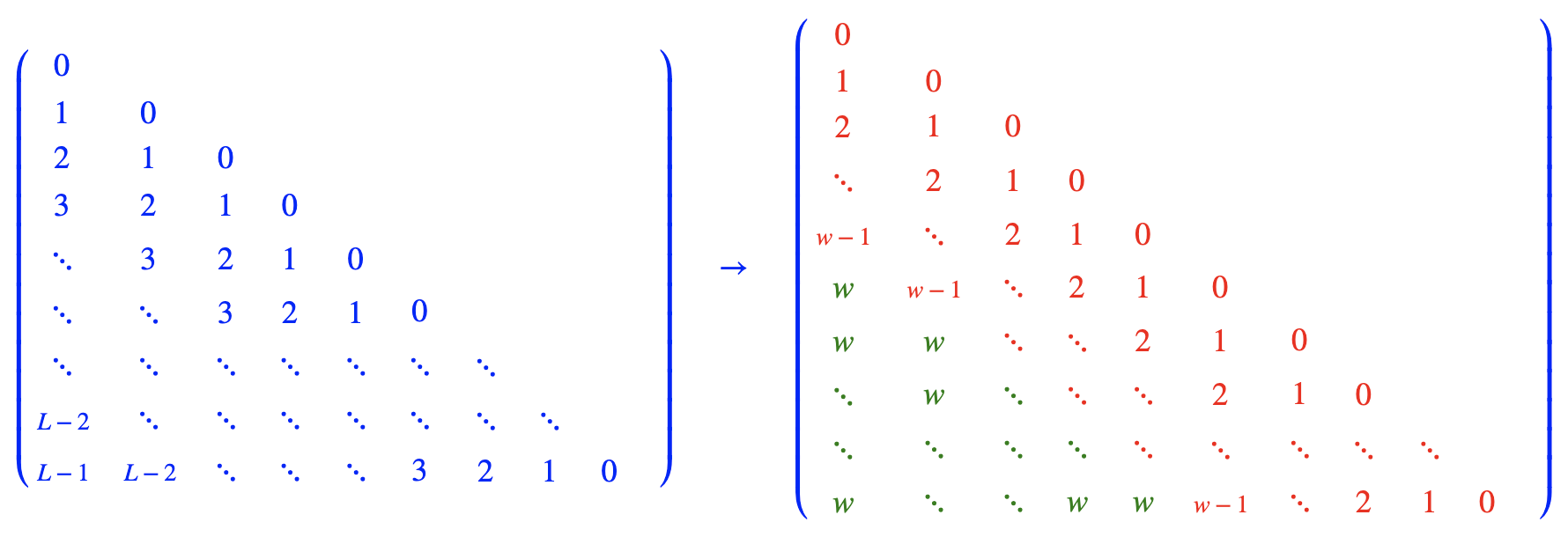
This approach combines direct extrapolation with position interpolation. A window size $w$ is established, where a position interval of $1$ is used within the window, and an interval of $\frac{1}{k}$ is applied outside. As $k \to \infty$, this simplifies to the form illustrated above. Under this scheme, the position encoding range never exceeds $w$ regardless of input length, potentially enabling support for arbitrarily long contexts.
The attention score calculation formulas are as follows,
$$ \begin{aligned} score_{ij}^{1} &= (q_iR_i)(k_jR_j)^T, && i-j<w \ score_{ij}^{2} &= (q_iR_w)(k_j)^T, && i-j\ge w \end{aligned} $$
ReRoPE extends context length effectively but requires double attention—local within w and global compressed—significantly reducing throughput. Despite this overhead, it remains valuable for training-free long contexts, especially when combined with local attention windows to balance efficiency.
🧠 Triton ReRoPE Implementation#
Load Data
Compared to the triton rope implementation, data loading requires passing query2 with alternative rotary embedding position and unrotated key2.
Construct ReRoPE Mask
During attention computation, the selection between attention score paths depends on the relative distance between query and key, necessitating construction of a rerope mask.
🏆 Results#
The Experiment Results#
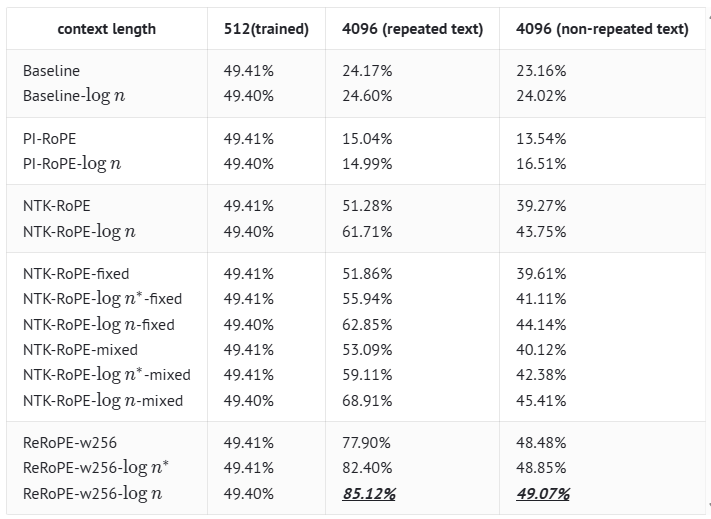
The experiment is based on a hybrid Transformer-GAU (Gated Attention Unit) model with a size of 100M parameters. $logn$ indicates we add the scale factor $log n$ at pretraining stage; $log n^{*}$ denotes we apply the scale factor to the attention matrix only for text exceeding the max sequence length, without any pretraining; $w256$ denotes the rerope windopw $w=256$.
🚀 Quick Start#
Installation#
For installation instructions, please refer to the UCM’s top-level README. Once UCM is installed, ReRoPE is naturally supported by running the following example scripts.
cd <path_to_your_vllm>
# Replace <version> with 0.9.2 or 0.11.0
git apply <path_to_ucm>/ucm/integration/vllm/patch/<version>/vllm-adapt-rerope.patch
export VLLM_ATTENTION_BACKEND=TRITON_ATTN_VLLM_V1
export VLLM_USE_REROPE=true
export ENABLE_UCM_PATCH=0
export DATA_DIR=/home/data/kv_cache
export MODEL_PATH=/home/models/Qwen2.5-14B-Instruct
export REROPE_WINDOW=32768
export TRAINING_LENGTH=32768
cd <path_to_ucm>
python examples/offline_inference_rerope.py
Note:
REROPE_WINDOWandTRAINING_LENGTHare generally set to the model’s pre-training length.For vLLM version 0.11.0, set
VLLM_ATTENTION_BACKENDtoTRITON_ATTN.
Basic Usage#
We need to modify the max_position_embeddings of the model according to the input length of prompts, as shown below.
llm_args = EngineArgs(
        model=model,
        kv_transfer_config=ktc,
        hf_overrides={
            "max_position_embeddings": 327680,
        },
        gpu_memory_utilization=0.9,
        max_num_batched_tokens=8192,
        block_size=16,
        enforce_eager=True,
        tensor_parallel_size=2,
    )
📊 Supported Models#
Qwen-based models now are available
🎓 Cite#
@misc{rerope2023,
  title={Rectified Rotary Position Embeddings},
  author={Jianlin Su},
  year={2023},
  howpublished={\url{https://github.com/bojone/rerope}},
}